Where the Marathon Came From and How It Became a Race
The marathon’s origin connects Greek messenger traditions with modern Olympic choices, clarifying why its name carries ancient meaning but its distance is modern.
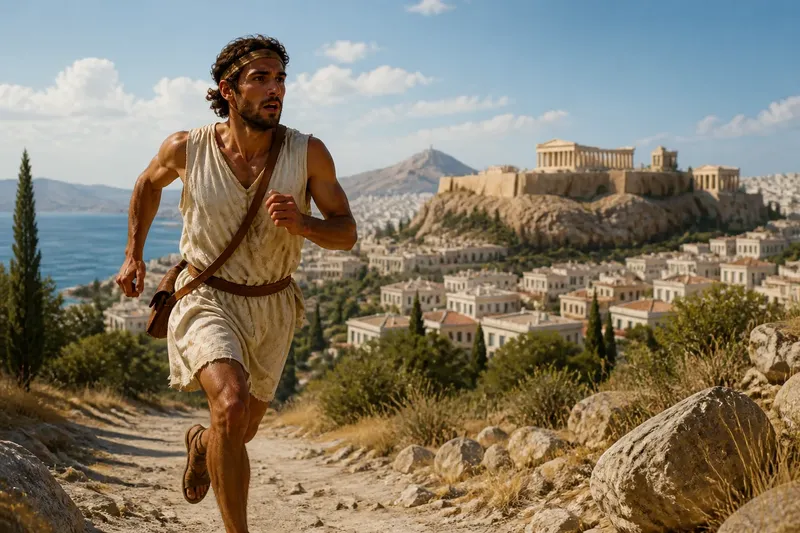
The marathon’s origin lies in a modern sporting decision built around an ancient Greek story, not in an ancient race carried intact into the present. That distinction explains why the event’s name evokes Marathon and Athens while its familiar format belongs to modern sport.
The familiar account is tidy: a messenger runs from Marathon to Athens, announces victory, and dies. The historical record is less tidy. The marathon took shape through several layers: ancient messenger traditions, nineteenth-century Olympic planning, and later decisions about course distance.
Ancient accounts preserve different messenger journeys
The Battle of Marathon took place in 490 BCE, when Athenian and Plataean forces fought a Persian invasion near the town of Marathon. The battle became a defining episode in Greek memory, and later readers found in it a fitting setting for a story about urgent news carried by a runner.
Herodotus describes Pheidippides traveling from Athens to Sparta before the battle to seek help. That journey is associated with the conflict, but it runs in the opposite direction from the familiar Marathon-to-Athens tale and serves a different purpose.
A separate tradition tells of a messenger reaching Athens after the battle. Later versions often give the runner the name Pheidippides and say that he died after announcing victory. Those details do not form one consistent account in Herodotus. Over time, separate traditions blurred into a vivid story with a route, a message, and a fatal ending.
The legend gives running a purpose beyond covering ground. The messenger’s effort connects a military event with the city waiting to learn its outcome. That sense of service and urgency became part of the race’s cultural identity, whether or not the familiar scene records one historical run.
The first modern Olympic marathon adapted the legend
When organizers planned the first modern Olympic Games in Athens in 1896, they sought events that could connect international competition with Greek antiquity. French educator and historian Michel Bréal is closely associated with proposing a race inspired by the Marathon-to-Athens story. The event was a modern creation, not an ancient Olympic discipline restored unchanged.
Runners competed on a course linking the Marathon area with Athens. The route made the historical reference visible: athletes moved through a landscape associated with the story the race was meant to evoke. The event could honor Greek heritage while introducing a new endurance contest to the Olympic program.
Organizers could have drawn on another messenger tradition or celebrated the battlefield without tracing a route to Athens. Instead, the Marathon-to-Athens story offered a simple arc from conflict to arrival. Its historical details did not need to be settled for the narrative to work as a public symbol.
Say an organizer wanted to create a ceremonial race based on a local story of a courier carrying urgent news. The organizer could follow the story’s geography or choose a safer route that preserves its arrival point. The first choice favors historical fidelity; the second favors a workable event. The 1896 organizers faced a similar choice between the old narrative and the demands of a modern competition.
The marathon distance was set by modern course choices
Early marathons varied in length because their courses followed local routes and organizing decisions. The 1896 race was not designed around a universal distance inherited from antiquity.
The distance familiar today took shape through later Olympic course planning. At the 1908 London Olympics, organizers set a course from Windsor Castle to the stadium, extending it for the event’s arrangements. That course became a reference point, and the distance was standardized at 26 miles and 385 yards, or 42.195 kilometers, in 1921. These details concern modern sporting rules, not a measurement preserved from an ancient messenger’s journey.
Standardization gave the event a consistent formal boundary, while its name continued to point toward Marathon and the Greek traditions associated with the race. The relationship is like a family recipe written down after years of improvisation: the name carries an older inheritance, while the exact instructions reflect later decisions.
Different origin questions call for different answers
- If you want to know why the race is called a marathon, look to the Marathon-to-Athens tradition and its cultural afterlife. If you need a firmly documented account of one ancient race, treat that tradition cautiously and distinguish it from Herodotus’s report of the journey to Sparta.
- If you want to know how the event entered the Olympics, focus on the 1896 revival and Bréal’s association with the proposal. If your question is about ancient Olympic competition, note that the marathon was a modern addition, not an ancient event revived unchanged.
- If you want to know why the distance is consistent today, look to later Olympic course choices and standardization. If your question is whether the ancient story fixed that distance, the answer is no: the formal distance came from modern sport.
- If you want to know why the legend endures, consider its clear human purpose: a runner carries urgent news to a city. If you are assessing historical detail, separate that lasting meaning from claims that the familiar story is a complete record of one event.
What do readers ask about the marathon’s origin?
Did Pheidippides run from Marathon to Athens?
A later tradition describes a messenger running to Athens after the battle, but ancient accounts do not give one consistent version of the familiar scene. Herodotus instead records Pheidippides traveling from Athens to Sparta before the fighting.
Was the marathon part of the ancient Olympic Games?
No. The marathon was created for the first modern Olympic Games in Athens in 1896, drawing on a story associated with ancient Greece. Its historical setting is ancient, but the event itself belongs to modern sport.
Why is a marathon 42.195 kilometers long?
The distance developed through modern course choices and was standardized in 1921. It was not fixed by the ancient story or by a documented route preserved from antiquity.
Why does the legend remain attached to the race?
The legend gives distance a purpose: carrying news from a moment of conflict to the people who need it. That meaning can endure even when the historical details remain uncertain.
The marathon remembers a story without reenacting it
The marathon’s beginnings are layered. Ancient Greek accounts preserve different messenger journeys; later retellings shaped the familiar run from Marathon to Athens; Olympic organizers turned that story into a modern race; and subsequent standardization established the event’s formal distance.
When you see “marathon” on a race bib, the word names a modern athletic event and invokes an older cultural inheritance. Keeping those two meanings distinct makes the history clearer: the legend explains much of the race’s identity, while modern sporting choices explain its format.