The First Aim: Giving a Practice Session a Clear Shape
A practice session aim gives you a concrete cue to follow, a way to review what happened, and a clearer basis for choosing your focus next time.
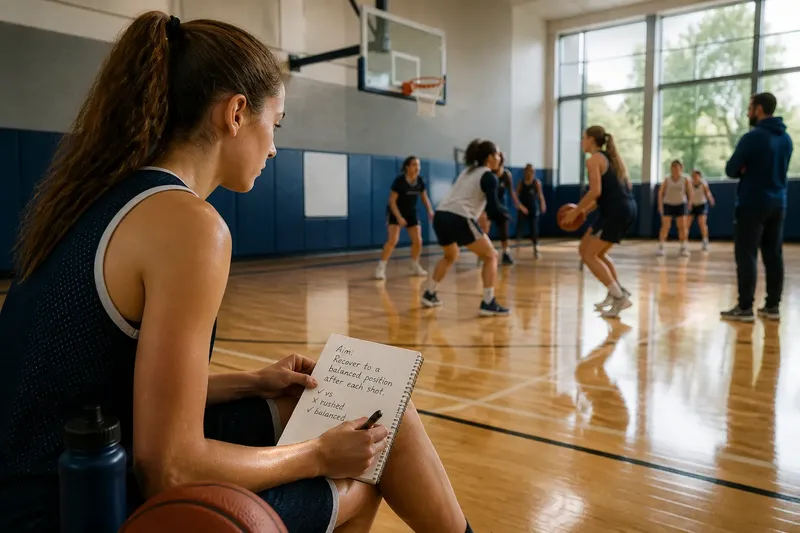
A practice session aim is most useful when it names something you can notice or do during the work. “Play better” asks for an outcome; “recover to a balanced position after each shot” gives you a cue to follow.
That distinction matters when a session gets difficult. An aim can keep your attention on a controllable action without turning every imperfect result into a verdict. It is a compass, not a promise.
A practice session aim should name one observable cue
Choose one behavior, decision, or moment to attend to. It should be easy to recall while moving and connected to the practice already planned.
A basketball player might focus on setting their feet before a catch-and-shoot attempt. A runner might notice whether their shoulders stay relaxed during an easy run. Neither cue is a scorecard; each helps the athlete direct attention amid competing demands.
Fit the aim to the session. If a coach has scheduled passing drills, an athlete might focus on presenting a clear target for a teammate. An unrelated personal project would be less like focus and more like changing the subject mid-conversation.
Choose a cue that fits the work in front of you
Start with a specific moment: the first touch, the transition after a turnover, the exhale before a lift, or the foot placement before a jump. Ask what you want to notice or do there. If your answer contains several actions, keep the one most connected to the planned practice.
Imagine a tennis player arriving for cross-court rallies with a tendency to rush the first shot after the opponent returns the ball. The player chooses “recover to a balanced position after each shot.” During the rally, they watch for that recovery; between points, they note whether they returned to balance or what interrupted it. The resulting observation is about the chosen movement, not a prediction about match results.
One cue does not prevent a coach from correcting another issue or a teammate from raising a concern. It gives you a default focus when several instructions compete for attention.
Let the aim guide attention without scripting every repetition
A drill contains changing situations, so the aim should influence what you watch rather than dictate a rigid response. If your focus is early communication in a defensive drill, notice whether your call gives a teammate useful information before they have to guess.
The wording may change with the play. Repeating a rehearsed phrase at the wrong moment is not especially useful, though it does have the virtue of being audible.
At a natural pause, ask whether you attended to the cue and what made that easier or harder. A brief check can inform the next attempt without turning practice into a running commentary on every movement.
Treat a coach’s feedback as information that may sharpen or replace your cue. A session aim should help you apply instruction, not become a private rule that overrides the person guiding practice.
Change the aim when it no longer fits
Change or drop the cue if the session shifts, the drill no longer calls for it, or a more immediate instruction needs your attention. Staying loyal to a note after it stops serving the work is loyalty to the note, not to practice.
Some aims are too broad to observe. “Stay confident” may be hard to translate into a movement or decision; “take a full breath before stepping to the line” offers a clearer point of attention. If a cue is not helping, simplify it rather than stacking on more cues.
For health or safety concerns, follow qualified guidance and the relevant coach’s or professional’s direction. An aim can support practice, but it cannot replace appropriate care.
Review what the cue helped you notice
After practice, record one brief observation: what you noticed, what helped, or what you might adjust next time. “I remembered the cue when the drill slowed down” describes an event. “I was bad at focus” turns one impression into a sweeping judgment.
You do not need to rate the whole session by how consistently you held the aim. Interruptions, difficult repetitions, and useful coaching can all belong to the same practice. The aim has served its purpose if it gave you a way to return your attention to the work.
What do athletes ask about a practice session aim?
Should every practice session have an aim?
An aim can help, but it need not be elaborate or different each time. If a coach has already set a clear focus, use that rather than inventing a competing one.
Can an aim focus on effort rather than technique?
Yes, if you connect effort to an observable choice, such as returning to your starting position between repetitions. “Try harder” gives little guidance about what to do next.
What if I forget the aim during practice?
Return to it at a natural pause, such as a water break or a reset between drills. Forgetting once does not spoil the session; the cue is there to guide attention, not police it.
Should I keep the same aim across several sessions?
You can keep it while the cue remains relevant to the work. Revisit it when the drills, coaching priorities, or your needs change instead of keeping it just because it is familiar.
A practice session aim works like a bookmark in a crowded book: it helps you return to a passage without pretending the rest of the pages do not exist. Choose a cue that fits today’s work, record what you noticed, and use that observation to decide whether the same focus still belongs in your next session.