The Progress Chart That Mistakes Every Pause for Failure
A progress chart can record pauses without treating them as failure, helping athletes see what changed, what held, and what deserves attention next.
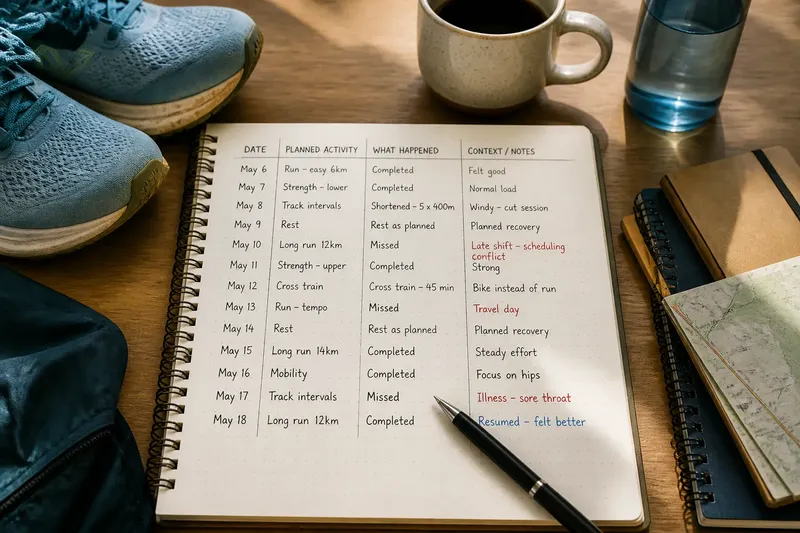
A progress chart can record a pause without calling it failure. For an athlete whose training has been interrupted by illness, travel, family demands, or a change in coaching, a blank stretch is not the same thing as lost effort. The record becomes more useful when it shows what happened, not only whether every planned session took place.
That distinction matters because a chart is a tool for making decisions, not a verdict on character. An unbroken row of marks may look tidy while concealing a changed routine or a sensible rest period. A useful record lets the athlete see both the work and the circumstances around it, then decide what to do next.
Choose a record that can hold context
Start with a format you can update without turning the task into another training session. A paper calendar, a notebook, or a simple spreadsheet can all work. Choose columns that leave room for more than a yes-or-no mark: date, planned activity, what happened, and a brief note about context.
Keep the fields limited. If each entry requires a detailed account, the record is likely to become a chore, especially during a demanding stretch. A few words such as “shortened for soreness,” “missed during travel,” or “rest as planned” can be more informative than a polished paragraph written much later.
Decide what the chart is meant to help you notice. It might track attendance, perceived effort, a skill you are practicing, or how consistently you recover between sessions. Avoid combining every possible measure in one place. A chart overloaded with scores can resemble a junk drawer: technically full of useful things, but not much help when you need one.
Define what counts before the first entry
Write down the activity or behavior you intend to record, and clarify what qualifies as an entry. If the aim is to practice a particular skill, decide whether a shortened session still counts as practice. If the aim is to follow a recovery plan, a rest day may be part of the plan rather than an empty space.
This definition should describe the work, not set a standard for worthiness. A session does not need to be long or impressive to be recorded. The chart is not a selection committee. It is a place to notice patterns in what you actually do and what conditions shape it.
Make room for changes in the plan. An athlete may shift from outdoor running to an indoor session because of weather, or replace a demanding workout with a recovery activity after discussing symptoms with a qualified clinician or coach. The entry should identify the change plainly, so later review does not confuse adaptation with disappearance.
Mark pauses with specific, neutral language
When a planned session does not happen, enter the reason if you know it. Use a short description rather than a judgment: “schedule conflict,” “rest day,” “illness,” “facility closed,” or “plan revised.” If the reason is unclear, “not recorded” is more accurate than inventing one after the fact.
Separate the event from your interpretation of it. “Two sessions missed during a work trip” is an observation. “I have no discipline” is a sweeping conclusion that a calendar cannot support. This separation does not excuse or condemn anything; it keeps the record useful enough to guide a decision.
Say you planned to practice serves after work, but a late shift pushed the session out of reach. You could mark the date “missed—late shift,” then note whether the following day’s plan changed. The expected observable result is modest: when you review the chart, you can see that the gap followed a scheduling constraint rather than an unexplained loss of interest. That may point toward adjusting the practice time, or it may simply describe a week that did not go to plan.
Resume without trying to repay the gap
After a pause, return to the current plan rather than treating missed sessions as a debt. Trying to compress skipped work into a crowded schedule can make the chart look active while obscuring whether the plan remains appropriate. The next session should be chosen for the athlete’s present circumstances, not to fill in a blank square.
If the pause involved pain, illness, or another health concern, use common sense and seek guidance from a qualified health professional when needed. Training decisions after an injury or significant illness are not well made by a calendar alone. Follow relevant clinical advice and the coach’s role where appropriate.
Record the return as its own entry. “Resumed with modified session” says more than drawing a line across the gap. It preserves the sequence: work, interruption, adjustment, return. That sequence is often the useful part, because it shows how the athlete responded when circumstances changed.
Review the chart for patterns, not streaks
Look back at a span that is long enough to include ordinary variation, and ask concrete questions. Which sessions happened as planned? What kinds of interruptions recur? Did a change in timing, location, or workload make participation easier? Are there signs that the plan needs discussion with a coach or health professional?
Do not treat a visible pattern as a verdict. Several entries linked to travel might suggest that the schedule needs flexibility; they do not prove that travel is the only cause. A chart can raise a useful question without supplying the answer. Compare it with what the athlete remembers and with the goals the record was meant to serve.
If you track effort or mood, keep those notes distinct from the activity itself. A session can happen while feeling unusually difficult, and a missed session can occur for reasons unrelated to motivation. Keeping separate observations helps prevent a single mark from carrying more meaning than it can bear.
How should a pause appear in the record?
Should a rest day count as progress?
Record a rest day when it belongs to the plan, especially if the chart tracks adherence to that plan. Whether it represents progress depends on the purpose of the record, so label it accurately rather than forcing it into a training category.
What if I do not know why I stopped?
Write that the reason is unknown, or leave a brief neutral note. A truthful gap in the explanation is more useful than a confident story assembled later.
Should I restart a streak after missing a session?
Only if streaks genuinely help you make decisions. If they turn one interruption into a judgment about the whole effort, track sessions, adjustments, or recovery instead of preserving an unbroken chain.
When should I change the chart?
Change it when the original fields no longer help you answer the question you set out to examine. Note the change so older entries are not mistaken for records made under the new approach.
Keep the record useful as circumstances change
Every so often, decide whether the chart still serves its purpose. An athlete who changes sports, coaching, work hours, or training goals may need different fields. Keep old entries intact, but make the new approach clear from the point it begins. A record that evolves honestly is more useful than one that stays neat by pretending nothing changed.
The practical test is whether the chart helps you choose a sensible next action. If it leads to a conversation with a coach, a revised schedule, or a clearer account of a pause, it has done useful work. The progress chart should preserve evidence of effort and interruption alike; the main phrase, progress chart, is not a promise of a smooth line but a way to see what happened well enough to continue with care.